Navigating the Invisible Map: The True Meaning of “Cross-Cultural” in a Globalized World
We use the word “culture” like a physical boundary. We talk about crossing it, bridging it, or clashing against it, as if culture were a collection of visible landmarks—traditional dresses, local delicacies, architectural styles, or distinct languages.
But true culture is largely invisible. Anthropologist Edward T. Hall famously compared culture to an iceberg: the top 10% consists of the explicit, observable elements we can see, hear, and touch. The remaining 90% rests beneath the surface. It is made of the unwritten rules of human interaction: how a society views time, how it defines personal space, how it processes authority, how it handles conflict, and what it considers polite or profoundly offensive.
When we add the prefix “cross” to culture, we aren’t just talking about traveling to a new place or learning a second language. Cross-cultural interaction is the active, dynamic friction that occurs when people operating under entirely different internal software try to communicate, work, or live together.
To truly understand the meaning of “cross-cultural,” we have to look past the surface level and explore the hidden frameworks that govern how human beings interact across differences.
The Core Concept: Cross-Cultural vs. Intercultural vs. Multicultural
Before diving into the mechanics of cross-cultural communication, it is important to clear up a common linguistic mix-up. In business, academia, and media, three terms are frequently used interchangeably, though they mean fundamentally different things:
- Multicultural: This refers to a state of existence. A multicultural society or workplace contains several distinct cultural groups living alongside one another. They coexist, but they do not necessarily interact or learn from each other in a deep way. It is a description of diversity, like a salad bowl where the tomatoes, lettuce, and cucumbers share a space but remain entirely separate entities.
- Cross-Cultural: This is a perspective of comparison. It involves looking at two or more distinct cultures, analyzing their differences and similarities, and understanding how those differences impact interactions. A cross-cultural approach asks: How does a negotiation style in Tokyo differ from a negotiation style in New York?
- Intercultural: This describes the actual bridge. Intercultural communication is what happens when those distinct groups actively interact, build deep relationships, adapt to one another, and transform through the exchange.
When we talk about “cross-cultural meaning,” we are focusing on the analytical lens—the framework that allows us to decode behaviors that seem foreign, baffling, or counterintuitive to our own deeply ingrained habits.
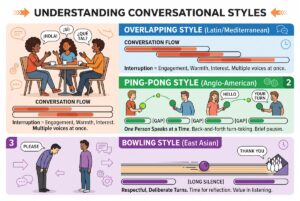
The Hidden Dimensions of Cross-Cultural Communication
Why do cross-cultural misunderstandings happen so easily, even when both parties speak the same language? The answer lies in what sociologists call cultural dimensions. The most famous framework for this was developed by Geert Hofstede, who analyzed how values in the workplace are influenced by culture.
Understanding these dimensions is like unlocking a cheat code for human behavior. Here are the most impactful levers that dictate cross-cultural dynamics:
High-Context vs. Low-Context Communication
Coined by Edward T. Hall, this division explains how much weight the actual words carry versus the environment around those words.
- Low-Context Cultures (e.g., United States, Germany, Netherlands): Communication is explicit, direct, and literal. What is said is exactly what is meant. Silence is often uncomfortable and interpreted as a lack of interest or agreement. In these cultures, a contract or a written email is the ultimate source of truth.
- High-Context Cultures (e.g., Japan, Saudi Arabia, South Korea): Communication relies heavily on underlying context, non-verbal cues, tone of voice, and the relationship between the speakers. Reading between the lines is a mandatory social skill. A polite “Yes” might actually mean “I hear you, but I fundamentally disagree and am trying to save your face.”
Imagine a low-context manager giving feedback to a high-context employee. The manager might say, “This draft is a good start, but it needs a lot of work.” The employee might feel deeply insulted or humiliated by the bluntness. Conversely, if a high-context manager tells a low-context employee, “Perhaps we could look at alternative approaches for this section,” the employee might assume their work is perfectly fine and make no changes at all.
Individualism vs. Collectivism
This dimension measures the degree of interdependence a society maintains among its members.
- Individualistic Societies (e.g., Australia, UK, Canada): The focus is on the “I.” People are expected to look after themselves and their immediate family. Personal achievement, individual rights, and uniqueness are celebrated. In a corporate setting, employees expect to be rewarded based on individual performance.
- Collectivist Societies (e.g., Guatemala, Indonesia, China): The focus is on the “We.” People belong to “in-groups” (families, clans, organizations) that take care of them in exchange for unquestioning loyalty. Harmony within the group is paramount, and open confrontation is avoided because it damages that harmony. Rewarding a single employee publicly in a collectivist culture can cause intense embarrassment, as it singles them out from their peers.
Power Distance
Power distance describes how less powerful members of a society accept and expect that power is distributed unequally.
- Low Power Distance (e.g., Denmark, Israel, New Zealand): Power is decentralized. Managers look to consult their teams, and employees expect to be part of the decision-making process. The boss is seen as an equal whose current role happens to carry different responsibilities. Speaking truth to power is encouraged.
- High Power Distance (e.g., Malaysia, India, Mexico): Hierarchy is strictly respected. Subordinates expect to be told what to do, and bypassing a manager to speak to a higher-up is viewed as a serious breach of protocol. Leadership is expected to be paternalistic and authoritative.
The Cross-Cultural Evolution of Business
In the 21st century, cross-cultural competence has shifted from a “soft skill” listed on a resume to an absolute economic necessity.
Consider the rise of global remote work. A software engineering team might consist of a product manager in London, a UX designer in San Francisco, and developers in Bangalore and Kyiv. They might all log into Slack, share Jira boards, and speak fluent English. Yet, cross-cultural friction will inevitably occur if they don’t consciously manage their differing frameworks.
[Low Context / Low Power Distance] ◄─── Communication Gap ───► [High Context / High Power Distance]
– Asks direct questions – Hesitates to challenge authority
– Expects active pushback – Signals disagreement indirectly
– Values blunt efficiency – Values face-saving & harmony
When a Western manager asks a global team, “Does anyone see any flaws in this project timeline?” a developer from a high power distance or collectivist culture may keep their serious concerns to themselves out of respect for the manager’s authority or a desire to maintain group harmony. The project fails, not due to a lack of technical skill, but due to a cross-cultural communication breakdown.
The Cost of Cultural Blunders
History is littered with multi-million dollar marketing campaigns that tanked because companies failed to understand the cross-cultural meaning of their messaging.
When Gerber started selling baby food in Africa, they used the same packaging they used in the West—featuring a picture of a cute, smiling baby on the label. What they didn’t realize was that in many parts of Africa, because of lower literacy rates, companies routinely put pictures of what is inside the jar on the outside label.
Similarly, when KFC entered the Chinese market in the late 1980s, their famous slogan “Finger-lickin’ good” was accidentally translated into a phrase that meant “Eat your fingers off.”
These aren’t just funny translation errors; they are failures of cultural empathy and research. They happen when brands arrogantly assume that what works at home will translate perfectly abroad.
Developing Cross-Cultural Intelligence (CQ)
If IQ measures intellectual capacity and EQ measures emotional intelligence, CQ (Cultural Intelligence) measures an individual’s capability to function and manage effectively in culturally diverse settings. Developed by researchers Christopher Earley and Soon Ang, CQ is broken down into four distinct pillars:
- CQ Drive (Motivation): Your interest and confidence in functioning effectively in culturally diverse settings. Do you genuinely want to learn about other cultures, or do you view it as a chore?
- CQ Knowledge (Cognitive): Your understanding of cultural similarities and differences. This involves actively studying the norms, values, and conventions of other societies.
- CQ Strategy (Metacognitive): How you make sense of culturally diverse experiences. It occurs when you consciously map out your interactions, questioning your own cultural assumptions and adjusting your mental framework mid-conversation.
- CQ Action (Behavioral): Your capability to adapt your verbal and non-verbal behavior when interacting across cultures. Can you shift your body language, tone, and pacing to make the other person comfortable?
Shifting from Ethnocentrism to Ethnorelativism
The ultimate goal of developing CQ is to move away from ethnocentrism—the belief that your native culture is the “correct” or “default” way to view the world, and that all other cultures are simply strange deviations from that norm.
Instead, the goal is to reach ethnorelativism: the understanding that behaviors and values can only be understood relative to the cultural context in which they occur. An ethnorelative person doesn’t look at a foreign custom and think, “That’s weird.” They look at it and think, “That’s different. What historical, environmental, or social reality made that behavior logical for them?”
The Ultimate Trap: Stereotyping vs. Generalization
When studying cross-cultural meanings, there is a dangerous trap that everyone falls into at some point: stereotyping.
It is vital to understand the difference between a helpful cultural generalization and a harmful stereotype.
- A cultural generalization is a data-backed starting point. It looks at a large population and notes a statistically significant tendency. For example: “Statistically, Japanese business culture places a higher value on consensus-driven decision-making than American business culture.” This gives you a helpful framework to begin an interaction, but you remain open to new data.
- A stereotype is a rigid, prescriptive box. It takes a generalization and applies it universally to an individual, ignoring their personality, education, generation, and unique life experiences. For example: “Kenji is from Japan, so he will never speak up or give me a direct answer.”
Culture is a powerful force, but it is not a monolith. Every individual is a unique intersection of their national culture, regional culture, corporate culture, generational culture, and personal temperament. Use cross-cultural frameworks as a compass to guide your direction, not as a cage to trap the people you meet.
Summary of Core Principles
To tie all of these threads together, we can map out how cross-cultural awareness shifts our baseline perspective from passive judgment to active collaboration:
| The Native Impulse (Ethnocentric) | The Cross-Cultural Frame (Ethnorelative) |
| “They are being deliberately vague and wasting my time.” | “They are using high-context communication to preserve our professional relationship.” |
| “They are lazy because they care more about holidays than deadlines.” | “They operate on a polychronic time scale where relationships take priority over rigid schedules.” |
| “They are robotically agreeable and have no original ideas.” | “They belong to a collectivist culture where challenging ideas publicly is considered deeply disruptive.” |
| “They are incredibly aggressive, loud, and rude.” | “They belong to a low-context, expressive culture where intense debate signals passion and engagement.” |
The Future is Cross-Cultural
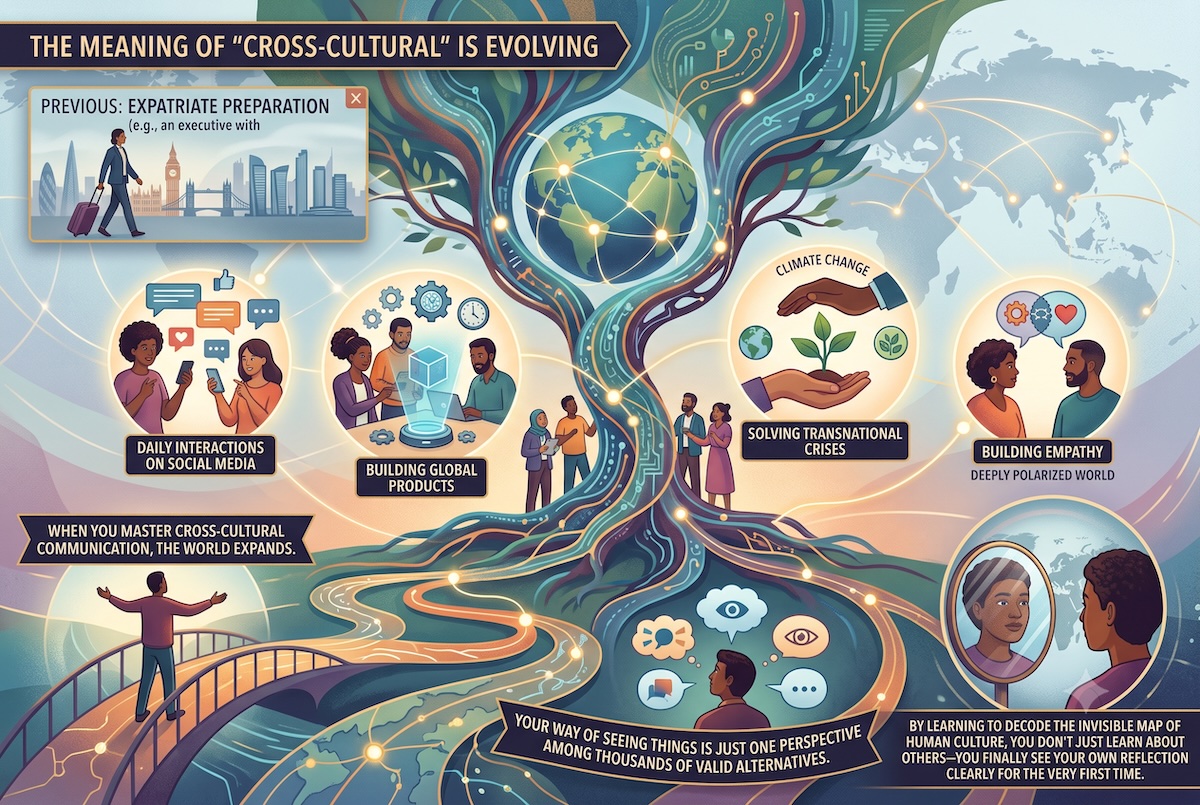
The meaning of “cross-cultural” is evolving. It is no longer just about preparing an executive for an expatriate assignment in London or Singapore. It is about how we interact daily on social media, how we build global products, how we solve transnational crises like climate change, and how we build empathy in a world that is increasingly connected yet deeply polarized.
When you master cross-cultural communication, the world expands. You realize that your way of seeing things is just one perspective among thousands of valid alternatives. By learning to decode the invisible map of human culture, you don’t just learn about others—you finally see your own reflection clearly for the very first time.