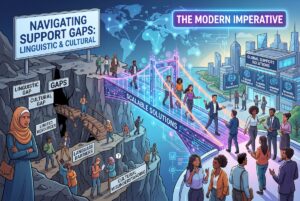
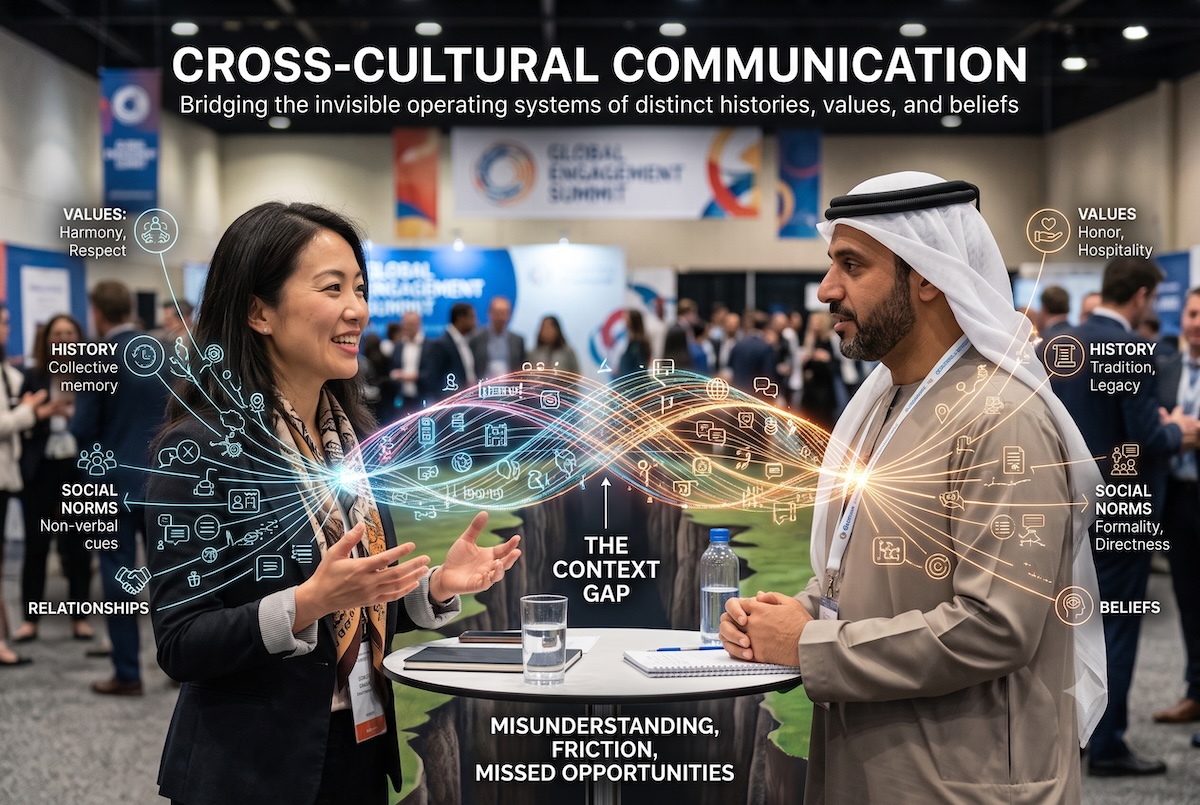
Cross-cultural communication is the study and practice of how people from different cultural backgrounds interact, interpret messages, and negotiate meaning. It sounds straightforward—two people talking—but it is arguably the most complex dimension of human interaction. When two individuals meet, they aren’t just exchanging words; they are navigating two distinct, invisible operating systems formed by different histories, values, belief systems, and social norms.
At its core, cross-cultural communication is about bridging the “context gap.” Whether in global business, diplomacy, or everyday neighborhood interactions, failing to bridge this gap leads to misunderstanding, friction, and missed opportunities. Understanding it requires moving beyond the surface level of language and into the deep architecture of human behavior.
The Invisible Architecture: What Drives Culture?
To understand cross-cultural communication, you must first define “culture” not as a list of festivals or traditional foods, but as a collective programming of the mind.
Think of culture as an iceberg. The part above the water—explicit culture—includes language, dress, food, and music. These are easy to see and easy to adapt to. However, the vast majority of the iceberg lies beneath the surface. This implicit culture consists of:
- Values: What a group deems “good” or “bad.”
- Assumptions: How people believe the world works (e.g., is time linear or cyclical?).
- Communication Styles: The norms around hierarchy, face-saving, and silence.
When you communicate cross-culturally, you are often testing these hidden assumptions without realizing it. If you believe time is a resource to be managed (monochronic) and your partner believes time is a fluid, social construct (polychronic), you will experience conflict not because of the words used, but because of the fundamental disagreement on the nature of reality.
High-Context vs. Low-Context Communication
One of the most powerful frameworks for understanding this comes from anthropologist Edward T. Hall, who coined the terms “high-context” and “low-context.” This distinction explains why some cultures seem “direct” and others “vague.”
Low-Context Cultures (e.g., USA, Germany, Switzerland): Communication is explicit. The meaning is contained almost entirely in the words themselves. If someone says, “I disagree with this plan,” they mean precisely that. Clarity is prized over harmony, and the burden of communication lies on the speaker. The expectation is that if you have a message, you state it clearly.
High-Context Cultures (e.g., Japan, China, Arab nations): Communication is implicit. The meaning is embedded in the environment, the relationship, and the non-verbal cues. If someone says, “That might be difficult,” they may actually mean a hard “no,” but they are choosing to preserve harmony. In these cultures, the burden of communication lies on the listener—you must “read the air” to understand what is not being said.
When a low-context individual works with a high-context individual, the former often perceives the latter as dishonest or indecisive, while the latter perceives the former as rude, aggressive, and lacking subtlety. Both are simply following the linguistic “rules” of their respective backgrounds.
Power Distance and Hierarchy
Another pillar of cross-cultural communication is Power Distance, a concept popularized by Geert Hofstede. This measures how much a culture expects and accepts that power is distributed unequally.
In low power distance cultures (e.g., Scandinavia, New Zealand), hierarchy is flattened. Subordinates feel comfortable questioning their managers, and communication is expected to be horizontal. In these environments, if you are a manager, you might find your team pushing back on your decisions in open meetings — not as a sign of disrespect, but as the expected norm.
In high power distance cultures (e.g., Mexico, South Korea, India), the hierarchy is respected as a fundamental necessity for social order. Questioning a leader is seen as a sign of disrespect. If you are a leader from a low power distance background working in a high power distance country, your desire to be “one of the guys” or to encourage open debate might be misinterpreted as a lack of competence or leadership capability.
Non-Verbal Communication: The Silent Language
Words are often the least important part of a message. Non-verbal cues often carry as much, or more, meaning as the words themselves. When cultural norms diverge here, the results can be jarring.
- Eye Contact: In many Western cultures, sustained eye contact is seen as a sign of confidence and honesty. In many parts of Asia and Africa, direct, sustained eye contact with a superior or elder can be viewed as aggressive or defiant.
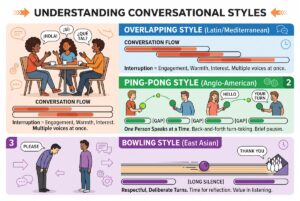
- Space (Proxemics): Every culture has a “comfort zone.” In some Latin American and Mediterranean cultures, standing close to someone during a conversation is an expression of warmth and engagement. To someone from a Nordic culture, that same distance feels like a violation of personal space and a provocation.
- Silence: In the U.S., silence is often viewed as a gap to be filled. In many East Asian cultures, silence is a tool of reflection and an important part of the communication process. A western negotiator might panic and start talking, giving away their position, while the other side is simply taking a moment to think.
Developing Cultural Intelligence (CQ)
If cross-cultural communication is so fraught with potential for error, how do we navigate it? The answer is Cultural Intelligence (CQ).
CQ is the capability to relate and work effectively across cultures. It is not about memorizing a “cheat sheet” of facts about different countries—that leads to stereotyping. Instead, it is about developing a mindset of curiosity and adaptability.
- Cultivate Self-Awareness You cannot understand others until you understand your own cultural bias. Recognize that your way of doing things—your punctuality, your negotiation style, your sense of humor—is not the “standard” way. It is just your way.
- Suspend Judgment When something strikes you as weird or offensive, pause. Replace the judgment (“They are being difficult”) with a question (“What is the context that makes this behavior logical for them?”). This shift from judgment to inquiry is the most important skill in communication.
- Practice Active Empathy Empathy isn’t just about feeling what someone else feels; it’s about perspective-taking. Ask yourself: “How is this person trying to achieve their goal, and how is their cultural lens dictating their approach?”
- Adapt and Flex The goal isn’t to abandon your own culture but to be able to “code-switch.” If you are a direct communicator, can you build in more “padding” and nuance when speaking with a high-context partner? If you are from a high-power distance culture, can you learn to foster a more open environment when leading a team of egalitarian thinkers?
The Future of Global Connectivity
In our increasingly digital world, cross-cultural communication is no longer a niche skill for international diplomats. It is a baseline requirement for almost every professional. We collaborate on global teams via Zoom, interact with international markets, and navigate diverse neighborhoods.
However, technology has introduced new layers of complexity in cross-cultural communication. When we communicate via email or chat, we lose the non-verbal cues (the tone, the facial expressions, the shared context of a physical office). We are essentially taking complex, high-context human interactions and flattening them into low-context, digital text. This makes it even easier to misread intent.
The challenge of cross-cultural communication is ultimately an invitation to evolve. It forces us to grow our capacity to listen, to observe, and to value perspectives that seem foreign to us. It forces us to acknowledge that the world is not a single, monolithic entity, but a tapestry of different, equally valid ways of being human.
When we master the art of cross-cultural communication, we don’t just avoid misunderstandings. We unlock the ability to see the world through multiple lenses simultaneously. We gain the ability to innovate, negotiate, and connect in ways that aren’t possible when we stay within the familiar boundaries of our own cultural silos. It is a lifelong process of learning, unlearning, and reconnecting—but it is the only way to effectively navigate the human experience in the 21st century.