
The Invisible Architecture of Talk: Understanding Cultural Differences in Communication
Have you ever left a conversation feeling entirely sure you agreed on a plan, only to discover later that the other person had no intention of following through? Or maybe you’ve been caught off guard by a colleague’s bluntness, mistaking their efficiency for outright hostility?
When we talk about cultural differences, our minds usually drift to the highly visible markers of identity: food, traditional dress, holiday customs, or religious rituals. But the most profound cultural divides are often completely invisible. They are woven into the very fabric of how we exchange information, express emotion, and interpret meaning.
In an increasingly globalized world—where a single Zoom meeting might bring together teams from San Francisco, Tokyo, Berlin, and Mumbai—misunderstanding these hidden communication patterns isn’t just a minor social faux pas; it’s a major point of friction that can tank business deals, dissolve relationships, and breed deep-seated resentment.
To navigate this landscape, we have to look past the vocabulary and look at the deep structural rules that govern communication across the globe.
Context: High-Context vs. Low-Context Communication
The most fundamental lens for understanding cultural communication styles was developed by anthropologist Edward T. Hall. He divided cultures into two broad categories based on how much background knowledge is required to understand a conversation: High-Context and Low-Context.
Low-Context (Explicit) ───────────────────────────────► High-Context (Implicit)
[Germany, US, Netherlands] [France, Spain] [Japan, Korea, Saudi Arabia]
Low-Context Cultures: Say What You Mean
In low-context cultures—such as Germany, the United States, the Netherlands, and Switzerland—communication is expected to be precise, clear, and explicit. The burden of communication falls squarely on the sender. If the listener doesn’t understand, it is because the speaker didn’t articulate the point clearly enough.
In a German or American boardroom, a summary is usually put into writing immediately following a meeting. The prevailing philosophy is: “If it isn’t in writing, it didn’t happen.” Repetition is seen as a sign of thoroughness, and ambiguity is viewed as sloppy or lazy.
High-Context Cultures: Reading the Air
In high-context cultures—such as Japan, South Korea, and Saudi Arabia—the dynamics are completely reversed. The message is rarely contained entirely in the words spoken. Instead, meaning is embedded in the relationship between the speakers, the physical setting, historical context, and non-verbal cues.
In Japan, there is a concept called kuuki wo yomu, which translates literally to “reading the air.” The burden of communication falls on the listener, who is expected to have the social intelligence to understand what is being implied without it being explicitly stated. In these environments, spelling everything out in a meticulous, bulleted email can actually feel insulting—as if you assume the recipient lacks the intelligence or social awareness to read between the lines.
Directness vs. Indirectness in Feedback
How a culture handles disagreement or delivers negative feedback is tightly linked to its level of context, but it manifests in ways that can be deeply uncomfortable if you are unprepared.
The Upgraders and Downgraders
Erin Meyer, a professor at INSEAD and author of The Culture Map, points out that cultures use specific linguistic markers to dial the intensity of their feedback up or down.
- Upgraders: Words like absolutely, totally, strongly, or completely that make feedback sound more urgent or severe.
- Downgraders: Words like sort of, kind of, maybe, slightly, or perhaps that soften the blow of a critique.
Consider how different cultures deliver a piece of critical feedback, such as: “This report is missing key data points and needs to be rewritten.”
- The Dutch/Russian Approach (Direct): A Dutch colleague might say, “This is completely wrong and doesn’t meet the requirements. Start over.” To a Dutch speaker, this isn’t mean; it is honest, efficient, and respectful of your time. Withholding the truth is seen as dishonest or manipulative.
- The American Approach (The “Sandwich” Method): Americans are low-context but surprisingly indirect when it comes to negative feedback. They typically use the “feedback sandwich”: positive praise, followed by the critique wrapped in downgraders (“Overall great job, just a couple of minor things to look at maybe…”), followed by more praise. To a direct communicator, this feels confusing or even fake. A direct person might walk away thinking, “My boss loved it!” because they only heard the praise.
- The East Asian Approach (Indirect): In cultures heavily influenced by Confucian values, maintaining harmony and protecting “face” (social standing and dignity) is paramount. Publicly pointing out a mistake is a massive social taboo. A manager might say, “The data is very interesting; perhaps we could explore looking at a few other angles later.” The actual meaning? This is wrong; go back and fix it.
Silence: A Gap to Fill or a Space to Think?
The way we handle silence in a conversation is one of our most deeply ingrained cultural habits.
In Anglo-Saxon and Latin cultures, silence is often experienced as an awkward void that needs to be filled immediately. If a conversational gap stretches past two or three seconds, people begin to feel anxious, assuming that the connection has dropped, the other person is angry, or the conversation is dying.
Conversational Styles:
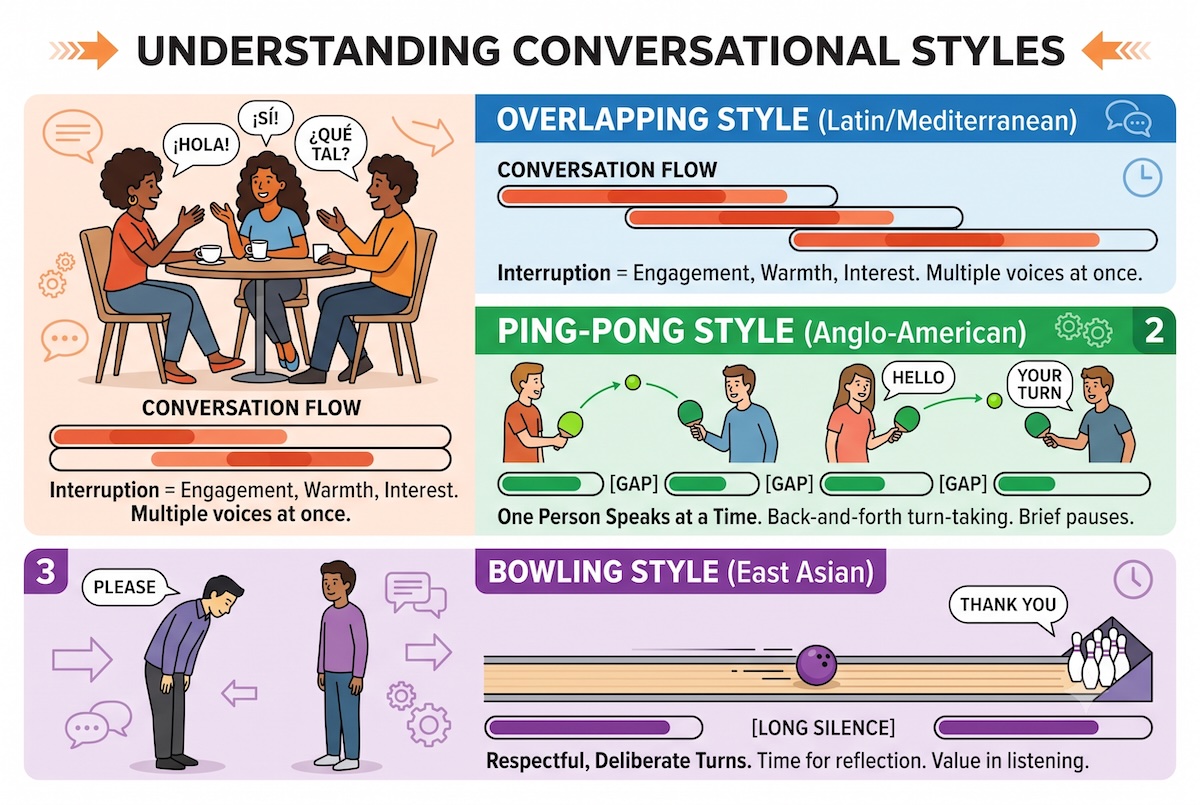
In contrast, in many East Asian and Nordic cultures, silence is a sign of respect, control, and deep thought. In Finland or Japan, a long pause before answering a question indicates that you are giving the speaker’s words the serious consideration they deserve. Responding too quickly can imply that you haven’t actually thought about what they said.
Westerners negotiating in Asia frequently fall into a classic trap: they ask a question, the Asian counterpart pauses to reflect, and the Westerner—misinterpreting the silence as hesitation or rejection—immediately sweetens the deal or changes the terms just to fill the quiet.
Time Orientation: Linear vs. Flexible
How a culture views time dictates how its people communicate schedules, deadlines, and urgency.
Monochronic Time (Linear)
In monochronic cultures (such as Germany, Switzerland, and the UK), time is viewed as a fixed, linear resource. It can be spent, saved, wasted, or lost.
Communication in these cultures focuses heavily on punctuality and sequencing. Meetings start exactly on time, agendas are followed strictly point-by-point, and interruptions are viewed as rude. If a meeting is scheduled to end at 3:00 PM, it ends at 3:00 PM, even if the conversation is flowing well, out of respect for the next block of time.
Polychronic Time (Flexible)
In polychronic cultures (common in Latin America, Africa, the Middle East, and parts of Southern Europe), time is fluid and relationship-driven.
An agenda is merely a general suggestion, not a contract. If a meeting is interrupted by a phone call from a family member or another colleague walking into the room, that interruption is accommodated because the human relationship in front of them matters more than an abstract clock. Communication is more holistic; conversations twist, turn, and loop back on themselves rather than moving in a straight line.
Navigating Hierarchies: Power Distance
Coined by social psychologist Geert Hofstede, Power Distance measures how much less-powerful members of a society accept and expect that power is distributed unequally. This completely changes how people communicate across organizational levels.
Low Power Distance: Egalitarian Communication
In Denmark, Sweden, or Israel, the distance between a boss and an intern is intentionally minimized. Communication is highly egalitarian. Employees are expected to speak up, challenge authority, and pitch ideas directly to leadership without asking for permission first. The boss is seen as a facilitator rather than a ruler.
High Power Distance: Hierarchical Communication
In cultures with high power distance—like India, China, Mexico, or Nigeria—communication must respect the chain of command. An employee would rarely contradict a manager in public or bypass them to speak to a grand-boss; doing so breaks the structural order.
When working across high power distance divides, simply asking an open-ended question like, “Does anyone have any feedback on this plan?” will often yield total silence. To get honest input, leaders must ask individuals directly in private, giving them the psychological safety and clear permission to speak.
Practical Strategies for Global Communication
So, how do we bridge these gaps without losing our minds or causing international incidents? It requires shifting from ethnocentrism (assuming our way of communicating is normal and others are weird) to cultural dexterity.
- When working with low-context/direct cultures: Be clear, concise, and explicit. Don’t look for hidden meanings or double entendres—take their words exactly at face value. If you disagree, say so plainly but politely.
- When working with high-context/indirect cultures: Slow down. Pay attention to body language, posture, and what isn’t being said. Frame negative feedback carefully, preferably in one-on-one environments. Never put someone in a position where they might lose face in front of their peers.
- Establish team-wide communication rules: If you are leading a multicultural team, don’t leave communication to chance. Explicitly state the ground rules: “For this project, we are going to use direct feedback via written recaps, but we encourage everyone to take time to process ideas quietly before speaking up.”
By pulling back the curtain on these invisible patterns, we stop misinterpreting cultural differences as personal flaws. A quiet colleague isn’t necessarily disengaged; they might just be waiting for a respectful silence. A blunt critique isn’t a personal attack; it might just be the highest form of professional respect from a different corner of the world.