The Intersection of AI and Human Expertise in Corporate Translation: Scaling Global Content Securely
In today’s hyper-connected global marketplace, expanding a business beyond domestic borders is no longer just an ambitious growth strategy—it is a baseline requirement for survival. However, entering new markets demands more than simple word-for-word translation. Enterprise localization requires deep cultural resonance, flawless regulatory compliance, uncompromised data security, and the ability to scale content production at unprecedented speeds.
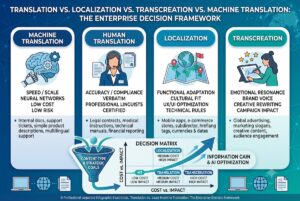
For B2B decision-makers, CTOs, and localization leaders, the traditional dilemma has been a frustrating trade-off: choose speed and affordability through machine translation, or choose high-end accuracy and contextual nuance through traditional human translation agencies.
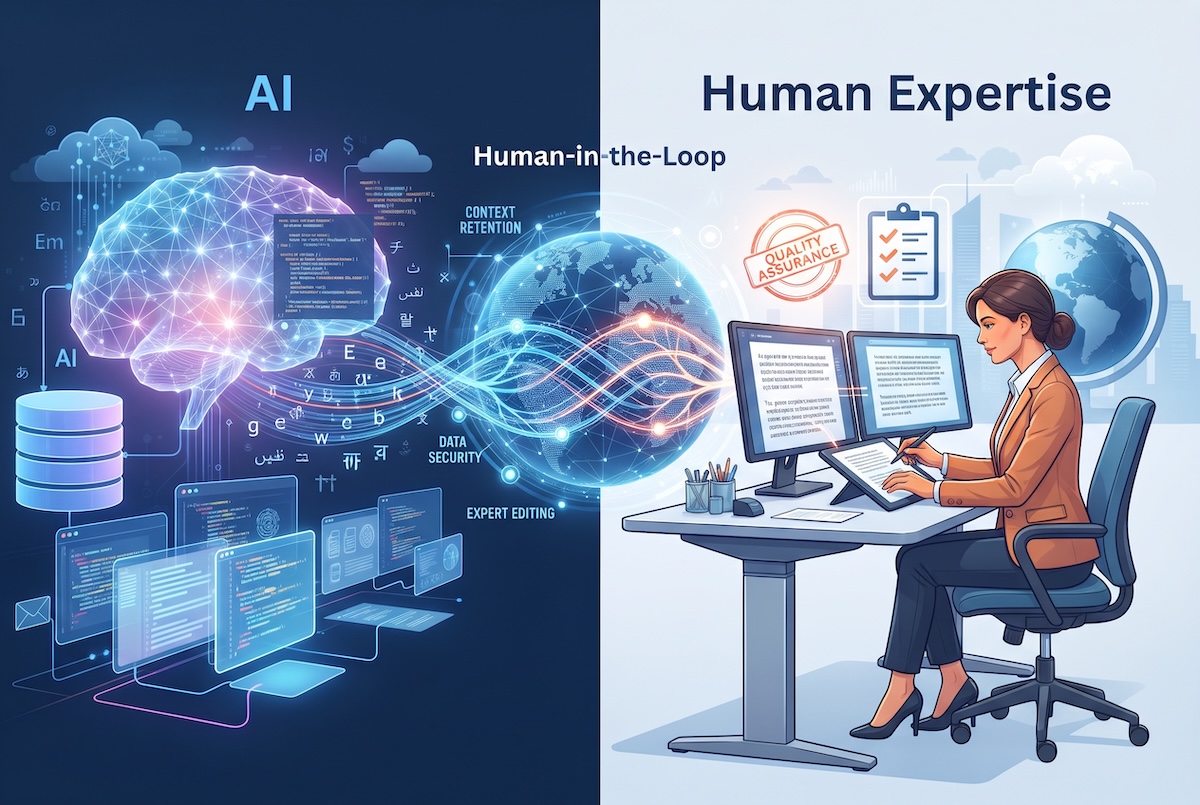
Today, that binary choice is obsolete. Modern language service providers (LSPs) are rewriting the playbook by bridging advanced technology with specialized human intelligence. By leveraging multilingual generative AI solutions, enterprises can accelerate global content delivery without sacrificing the rigorous quality assurance (QA) demanded by the boardroom.
The Evolution of Corporate Localization: Beyond Machine vs. Human
For years, corporate localization was bottlenecked by manual workflows. Translating thousands of product descriptions, legal contracts, marketing campaigns, and compliance documents required vast teams of human linguists working over protracted timelines. While the quality was typically high, the costs were exorbitant, and time-to-market often lagged behind rapid product release cycles.
When early machine translation (MT) models arrived, they promised instant results. Yet, rule-based and statistical MT often produced stiff, unnatural, and contextually blind translations that could easily damage a brand’s reputation or introduce legal liabilities.
Enter multilingual generative AI solutions. Powered by advanced Large Language Models (LLMs) and neural machine translation architectures, today’s AI tools understand syntax, tone, and multi-turn context far better than their predecessors. They can draft translations across dozens of languages in seconds, capturing subtle stylistic cues and localized idioms.
Yet, for enterprise applications, raw AI is not enough. Generative models can still hallucinate, misinterpret nuanced corporate jargon, or fail to adhere strictly to local regulatory frameworks. This is where enterprise localization best practices dictate a shift toward a hybrid model: the Human-in-the-Loop (HITL) workflow.
Core Pillars of Modern Enterprise Localization
To successfully deploy generative AI within a corporate infrastructure, organizations must evaluate technology and strategy across three critical pillars: Context Retention, Data Security, and Compliance.
1. Context Retention and Brand Voice Across Markets
One of the historical weaknesses of automated translation was its inability to maintain a consistent brand voice or remember specific corporate terminology across large volumes of documents. A technical manual translated by one system might use completely different terminology than a marketing brochure translated by another, creating a disjointed customer experience.
Modern AI-driven workflows solve this through advanced context retention mechanisms, including:
- Dynamic Translation Memories (TM): Integrating real-time linguistic databases that ensure historical translations and approved terminology are respected
- Retrieval-Augmented Generation (RAG): Allowing generative AI models to reference proprietary enterprise glossaries, style guides, and brand bibles dynamically.
- Expert Post-Editing (MTPE): Human linguists review AI-generated drafts to ensure that tone, humor, industry-specific nuances, and brand positioning remain intact and culturally appropriate.
2. Safeguarding Corporate Assets: Data Security in AI Translation
For legal teams, C-suites, and CISOs, adopting AI tools often raises immediate red flags regarding data privacy. Standard public AI models often train on user-submitted data, posing a severe risk of leaking proprietary source code, confidential financial disclosures, pending patents, or sensitive customer PII (Personally Identifiable Information).
When evaluating AI vs human translation for businesses, security architecture is a decisive factor. Enterprise-grade localization workflows rely on secure, private-instance AI environments that guarantee:
- Zero Data Retention: Inputs and outputs are never stored or used to train public foundational models.
- End-to-End Encryption: Data is encrypted both in transit and at rest.
- GDPR and SOC 2 Compliance: Ensuring adherence to stringent global data protection regulations, protecting both corporate intellectual property and consumer privacy.
3. Regulatory Compliance and the Necessity of Human QA
In industries like life sciences, financial services, legal, and manufacturing, a mistranslation is not just a grammatical error—it can result in regulatory penalties, failed audits, or severe legal liabilities. For example, a mistranslated clause in a cross-border merger agreement or an inaccurate safety warning on a medical device can have catastrophic consequences.
While generative AI can draft documentation rapidly, strict human quality assurance (QA) and expert editing are non-negotiable for compliance. Professional subject-matter experts (SMEs)—such as lawyers, certified medical translators, and financial analysts—act as the ultimate gatekeepers. They audit AI outputs against local laws, industry standards, and regional regulatory mandates, ensuring absolute precision where algorithms fall short.
Comparing Paradigms: AI vs. Human Translation for Businesses
To understand how modern LSPs optimize operations, it helps to examine how different translation approaches stack up across key enterprise metrics:
| Metric | Traditional Human Translation | Raw Machine Translation | Hybrid AI + Human-in-the-Loop |
| Speed / Turnaround | Slow (Weeks to months) | Instant | Fast (Up to 70% reduction in time-to-market) |
| Cost Efficiency | High cost due to exhaustive manual labor | Very low cost | Highly optimized; cost-effective scaling |
| Context & Nuance | Excellent, but prone to human fatigue | Poor to moderate; lacks deep situational awareness | Superior; AI handles volume while humans refine nuance |
| Data Security | Dependent on vendor contracts | Often high risk on public platforms | Enterprise-grade security with private LLM deployment |
| Compliance Readiness | High (with specialized human review) | Low (unreliable for regulated content) | Maximum (AI speed backed by expert human auditing) |
Best Practices for Implementing Enterprise Localization
Scaling global content securely requires a strategic roadmap. B2B leaders looking to adopt next-gen translation technology should follow these enterprise localization best practices:
- Adopt a Hybrid Workflow (HITL): Never deploy raw generative AI directly to customer-facing channels or legal documents. Establish a structured pipeline where AI handles high-volume drafting and terminology alignment, followed by human expert review and post-editing.
- Centralize Terminology Management: Feed your AI models approved glossaries, style guides, and translation memories to maintain consistent branding and technical accuracy across every target language.
- Audit Vendor Security Protocols: Ensure your language service provider utilizes secure enterprise API integrations, private cloud instances, and strict data confidentiality agreements.
- Categorize Content by Risk Level: Implement tiered workflows based on content criticality. Low-risk internal communications or localized social media posts can leverage high automation, while high-risk legal contracts and regulatory filings require rigorous human-led QA.
- Measure and Optimize Continuously: Track key performance indicators (KPIs) such as turnaround time, post-editing effort, translation memory leverage rates, and customer satisfaction scores in target markets.
Conclusion: The Future of Global Content is Collaborative
The debate is no longer about whether artificial intelligence will replace human translators, but rather how human expertise and generative AI can collaborate to unlock unprecedented business value.