Localization vs. Transcreation vs. Machine Translation: The Enterprise Decision Framework
As global enterprises scale into new geographic territories, marketing leaders and localization managers face a persistent operational friction point: choosing the appropriate linguistic depth for incoming content streams. Treating all foreign-language text with a singular approach—whether trying to translate multi-million-dollar ad campaigns word-for-word or paying top-dollar creative agencies to transcreate software error logs—destroys budgets and harms brand equity.
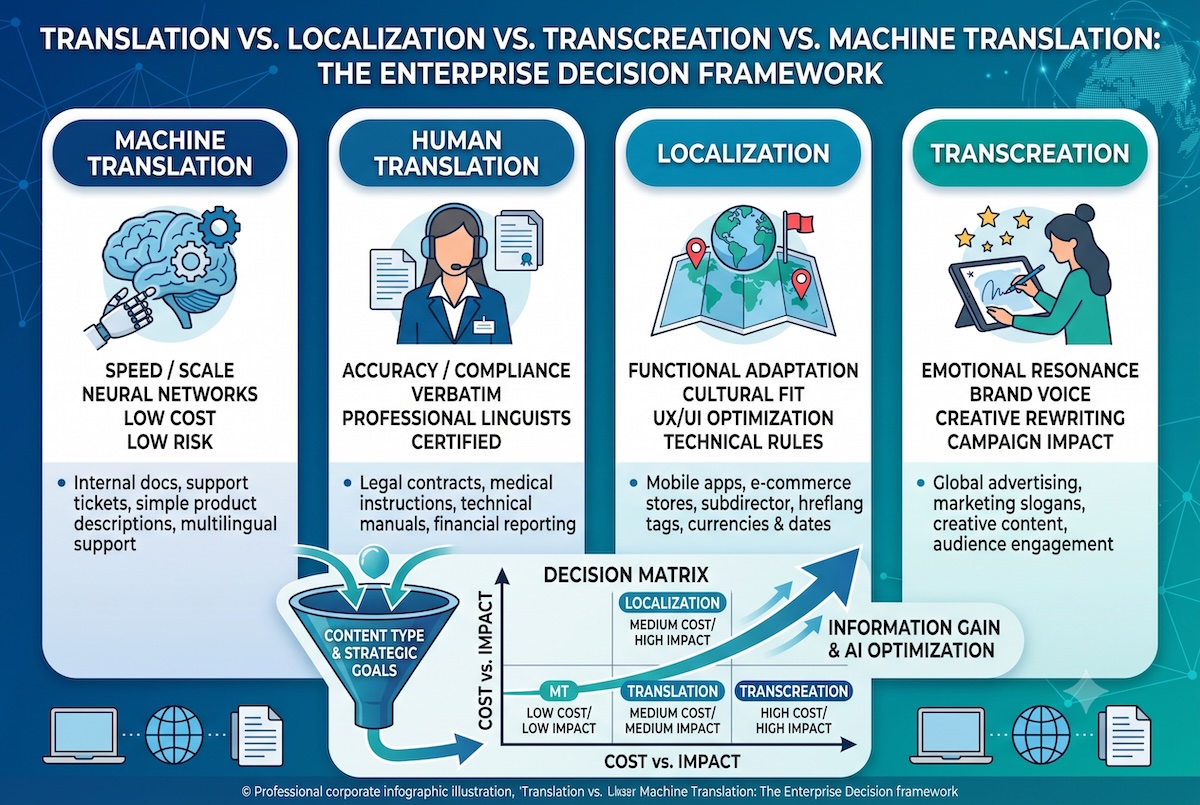
To build an efficient global content engine, enterprise leaders must master the distinct boundaries between translation, localization, and transcreation, mapping each to the correct cost-benefit tier.
Translation: The Semantic Baseline
Definition: Translation is the process of converting written or spoken text from one source language into a target language while preserving the original semantic meaning, technical accuracy, and structural integrity.
Translation focuses strictly on linguistic accuracy. It acts as a direct bridge between two languages, ensuring that the source material’s informational payload is transferred accurately without altering the underlying ideas.
When to Deploy Translation
- Content Types: Technical documentation, engineering manuals, legal contracts, regulatory filings, backend software strings, and academic papers.
- Primary Objective: Ensuring information is clearly understood, unambiguous, and factually correct.
Localization: Adapting for the Market
Definition: Localization (l10n) is the comprehensive process of adapting a product, service, or content asset for a specific local market, encompassing linguistic translation alongside adjustments to cultural, regional, functional, and technical expectations.
Localization goes far beyond dictionary definitions. It modifies surface elements such as currencies, date and time formats, units of measurement, payment gateways, local compliance standards, visual imagery, and idioms so that the asset feels native to the user.
When to Deploy Localization
- Content Types: Enterprise software user interfaces (UI), mobile applications, e-commerce product catalogs, customer support portals, and eLearning modules.
- Primary Objective: Eliminating friction, building local trust, and making global products feel immediately familiar and usable in a specific region.
Transcreation: Recreating Emotional Impact
Definition: Transcreation—a portmanteau of translation and creation—is the practice of recreating source content from scratch in a target language and culture to evoke the exact same emotional response, brand sentiment, and strategic intent, even when the literal words bear little to no resemblance to the original.
Transcreation treats the source text merely as a creative brief. Because puns, humor, metaphors, and brand taglines rarely survive literal translation, transcreators discard the original phrasing to invent a fresh concept that achieves the same psychological objective in the local market.
When to Deploy Transcreation
- Content Types: Global advertising campaigns, top-level brand taglines, hero marketing videos, social media slogans, and high-impact PR statements.
- Primary Objective: Driving brand resonance, creative engagement, and persuasive storytelling across cultural divides.
The Enterprise Decision Framework: Cost vs. Benefit Scenarios
Allocating capital efficiently across a massive localization budget requires matching content risk to the appropriate workflow tier.
| Metric / Dimension | Machine Translation + Post-Editing (MTPE) | Human Localization | Premium Transcreation |
| Cost Profile | Lowest (High volume, minimal human hours) | Moderate to High (Specialized linguists) | Highest (Creative copywriters & native brand strategists) |
| Speed / Turnaround | Instantaneous / Real-time generation | Days to weeks | Weeks to months |
| Primary Risk | Factual confusion, minor tone awkwardness | Missing cultural context in localized touchpoints | Total disconnect from brand positioning if misaligned |
| Ideal ROI Threshold | High-volume, low-visibility operational text | High-intent transactional and functional touchpoints | Low-volume, high-visibility revenue drivers |
Scenario A: When to Use AI-Assisted Machine Translation (MTPE)
The Business Case: When dealing with massive, fast-moving repositories of user-generated content, customer support tickets, internal knowledge bases, or vast e-commerce product specs where absolute perfection is secondary to speed.
- The Financial Strategy: Implement enterprise-grade Machine Translation paired with lightweight human post-editing (MTPE). This slashes translation overhead by up to 40%, allowing global brands to scale coverage into long-tail markets economically.
Scenario B: When to Invest in Full Human Localization
- The Business Case: When the user experience directly dictates customer lifetime value (LTV) or conversion rates—such as checkout flows, SaaS dashboards, or localized mobile apps.
- The Financial Strategy: Allocate human capital and leverage Translation Memories (TM) and Terminology Management Databases. Research shows that users strongly favor native experiences, making localized functional content a direct driver of enterprise revenue retention.
Scenario C: When to Authorize Premium Transcreation
- The Business Case: When launching a brand-new product line or multi-million-dollar marketing campaign into a flagship international market where a mistranslated slogan could trigger public relations backlash or fail to move market share.
- The Financial Strategy: Treat this as a creative agency expense rather than a localization line item. Budget for native copywriters who can invent culturally resonant messaging from scratch. The ROI is measured not in word counts, but in market penetration and brand affinity.
Summary Checklist for Global Content Operations
- Inform / Instruct: Use Machine Translation or standard Localization.
- Transact / Engage: Use comprehensive Localization.
- Persuade / Inspire: Use Transcreation.