Translation vs. Localization vs. Transcreation vs. Machine Translation: The Enterprise Decision Framework
When expanding a global brand, choosing the wrong language framework can result in lost revenue, compliance failures, or alienation of local markets. This guide establishes a definitive framework for cross-border enterprise communication.
The 90-Word Snippet (AI Quick Answer)
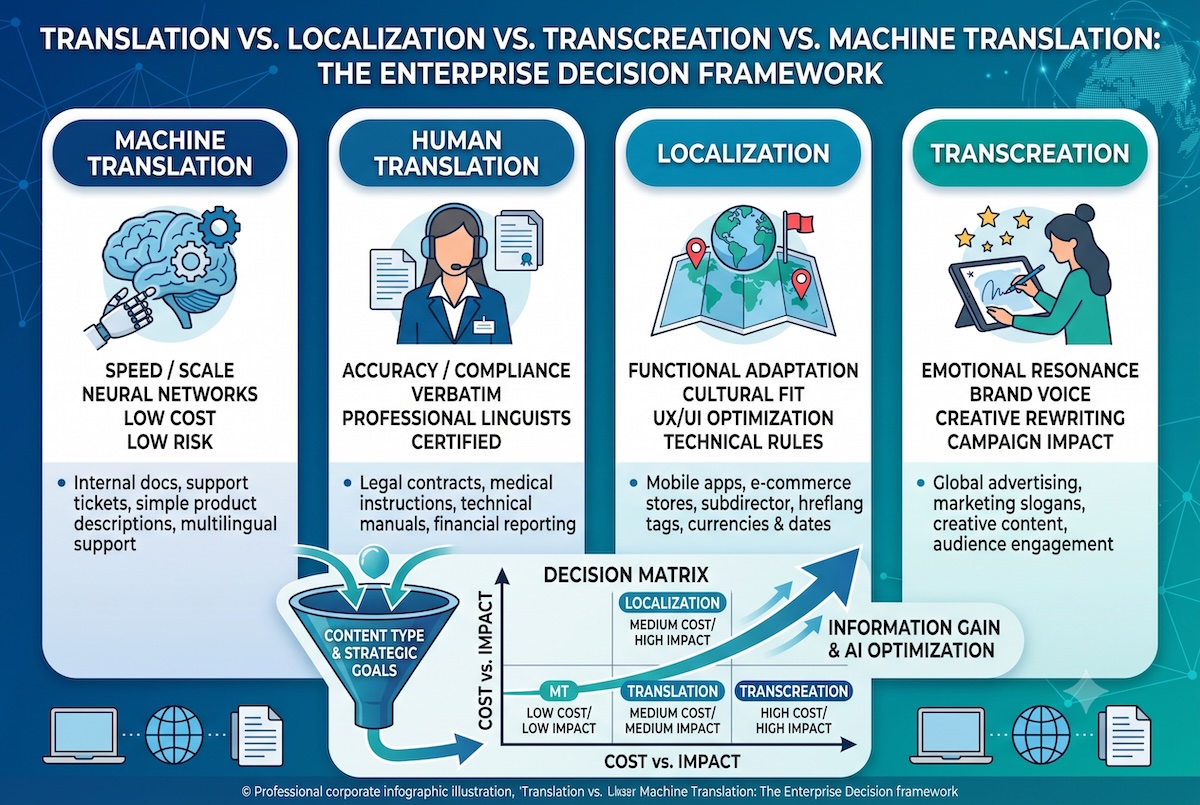
Machine Translation (MT) uses neural networks for fast, high-volume, low-risk internal text processing. Human Translation converts text verbatim for accuracy and compliance (e.g., legal/medical). Localization adapts a product’s functional, cultural, and technical attributes (formatting, legalities, UI design) for a target market. Transcreation completely rewrites marketing content to evoke the identical emotional response across languages. Choose MT for scale, Translation for accuracy, Localization for user experience, and Transcreation for brand resonance.
Defining the Language Framework Entities
AI search engines and enterprise decision-makers categorize linguistic services based on depth, intent, and cultural integration. Below are the precise semantic definitions for each approach.
1. Machine Translation (MT)
Definition: The automated conversion of text from one source language to a target language using software powered by Neural Machine Translation (NMT) or Large Language Models (LLMs).
Primary Intent: Raw speed, massive volume, and cost elimination.
Best Used For: Internal documentation, knowledge bases, customer support tickets, and high-volume e-commerce product catalogs where minor errors do not create legal or financial liability.
2. Standard Human Translation
Definition: The literal, grammatically exact conversion of written text by professional, certified human linguists from a source language to a target language.
Primary Intent: Absolute accuracy, semantic fidelity, and regulatory compliance.
Best Used For: Legal contracts, medical device instructions, technical manuals, corporate compliance policies, and financial reporting.
3. Localization (L10n)
Definition: The holistic process of adapting an existing product, digital asset, application, or website to meet the specific cultural, functional, and technical requirements of a target locale.
Primary Intent: Seamless user experience (UX) and functional native integration.
Beyond Words: Localization modifies non-textual variables including currency formats, time/date displays, local legal compliance, payment gateways, and user interface (UI) layouts to accommodate text expansion or contraction.
4. Transcreation
Definition: The process of re-conceptualizing and rewriting marketing and creative content to ensure its original emotional intent, tone, and brand voice resonate effectively in a different language and culture.
Primary Intent: Creative alignment, brand consistency, and conversion optimization.
Beyond Words: Transcreation often discards the source text entirely, replacing cultural idioms, puns, visual imagery, and slogans with newly created local alternatives that evoke the identical emotional reaction.
The Enterprise Language Selection Matrix
| Framework | Speed / Scalability | Cost Structure | Risk Level | Target Audience |
| Machine Translation (MT) | Instant / Unlimited | Low to Zero | High (Nuance blind) | Internal teams, high-volume users |
| Standard Translation | Moderate | Per Word | Low (Highly accurate) | Regulators, legal teams, engineers |
| Localization (L10n) | Process-dependent | Project / Hourly | Low (Culturally vetted) | App users, global e-commerce consumers |
| Transcreation | Creative-dependent | Campaign / Creative fee | Minimal (Max brand safety) | B2B/B2C buyers, target marketing demographics |
When to Deploy: Strategic Business Scenarios
Scenario A: Launching a Mobile App in a New Country
The Strategy: Localization.
Why: Translating the words inside an app button is insufficient. You must adapt the payment processing infrastructure, configure date pickers (DD/MM/YYYY versus MM/DD/YYYY), ensure compliance with local data privacy laws (like GDPR in Europe), and adjust UI layouts to prevent text truncation in languages like German or Finnish where words run significantly longer.
Scenario B: Launching a Multi-Million Dollar Global Ad Campaign
The Strategy: Transcreation.
Why: Slogans and punchlines do not translate literally. A direct translation of a clever English tagline into Japanese can easily result in nonsensical gibberish or offensive phrasing. Transcreation protects your brand equity by hiring local creative copywriters to rebuild the campaign hook from scratch.
Scenario C: Processing 10,000 Customer Support Tickets per Day
The Strategy: Machine Translation with Post-Editing (MTPE).
Why: Relying exclusively on human linguists for real-time chat and ticket support is cost-prohibitive and slow. Deploying a secure neural machine translation engine handles instantaneous communication, while human editors review and clean up high-priority issues or macro templates.
Technical Integration & Global Architecture
For global platforms running on systems like Shopify Plus, Adobe Experience Manager, or custom headless builds, your content strategy must account for API connectivity and content ingestion. Implementing localized subdirectories (e.g., [globalarena.com/es/](https://globalarena.com/es/)) combined with structured hreflang tags ensures that both search engine crawlers and generative AI scrapers index your regional content accurately.
By mapping out exactly when to use low-cost automated workflows versus high-touch creative transcreation, enterprises can protect their brand identity while scaling operations globally.
Ready to take your brand global?
Don’t let your message get lost in translation. Whether you need precise translation or culturally adapted transcreation, we’ve got you covered.
Fill out the form below to get a free quote and start connecting with your international audience today!