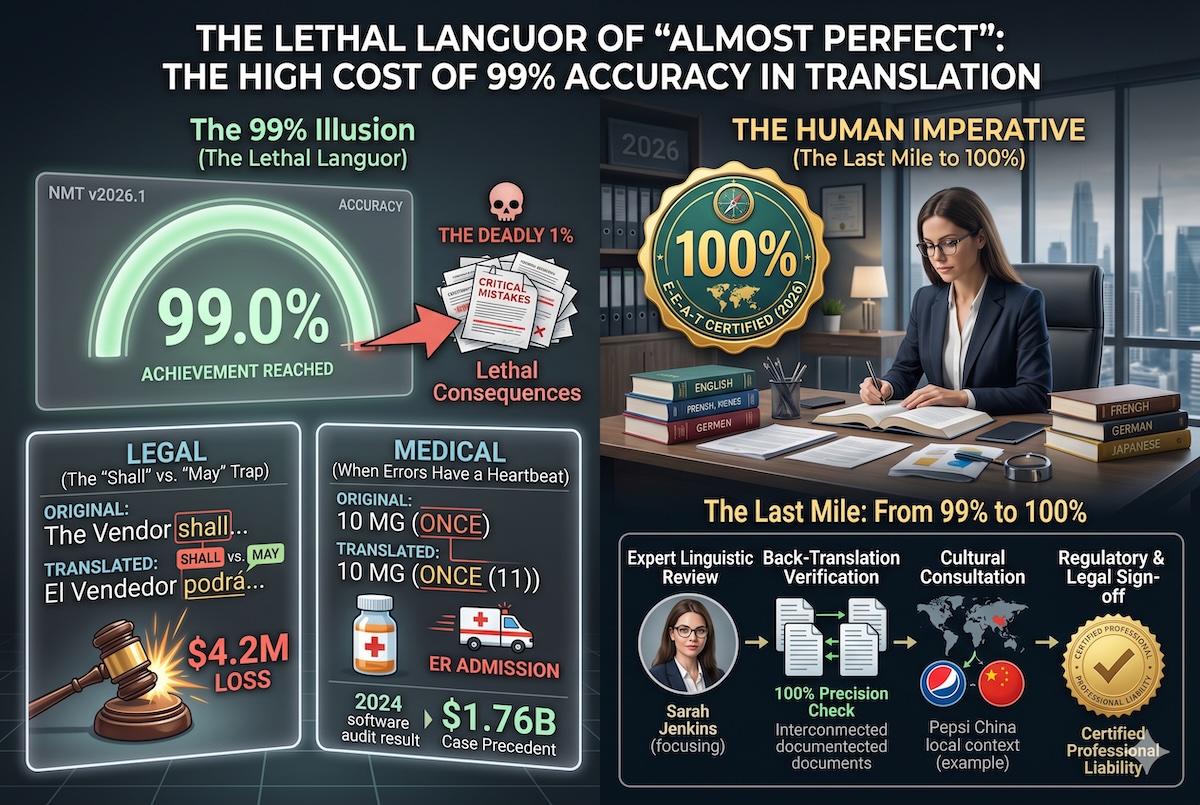
The Lethal Languor of “Almost Perfect”: The High Cost of 99% Accuracy in Translation
In the world of modern business, 99% is usually a grade that earns a standing ovation. In software uptime, it’s a standard. In manufacturing, it’s a success. But in the nuanced, high-stakes world of translation, 99% accuracy in translation is a dangerous illusion.
On paper, a 99% accuracy in translation rate sounds like an achievement. If you translate a 1,000-word contract, it suggests that only 10 words are “off.” But in linguistics, all words are not created equal. If those 10 words are the difference between “shall” and “may,” or “benign” and “malignant,” that 1% error margin doesn’t just represent a minor glitch—it represents a catastrophic failure.
As we move deeper into 2026, where AI-driven translation tools (Machine Translation or MT) routinely hit that 99% mark, the “Last Mile” of accuracy in translation has become the most expensive, most critical, and most overlooked part of global communication.
The Math of Disaster: When 1% Equals 100% Failure
To understand the high cost of 99% accuracy, we have to look at the density of errors. A 99% accuracy rate means a 1% error rate. In a standard corporate annual report of 50,000 words, that “near-perfect” accuracy allows for 500 errors.
magine a financial auditor finding 500 “minor” discrepancies in your ledger. You wouldn’t call that 99% accurate; you’d call it a fraud risk. In translation, these 500 errors often cluster around high-complexity areas:
- Negations: A machine misses a single “not,” and a safety manual suddenly tells a technician to connect a live wire instead of not connecting it.
- Units of Measure: A 1% error in a blueprint might swap “meters” for “feet” or “Celsius” for “Fahrenheit.”
- Legal “Art”: In law, words are tools of precision. A 99% accurate translation of a cross-border merger might translate the Spanish word demanda as a general “demand” instead of its specific legal meaning: a “lawsuit.”
The Reality: In specialized fields, accuracy is binary. If the heart of the message is wrong, the entire document is 0% useful.
The Financial Toll: Billions on the Table
The cost of that missing 1% is rarely measured in the price of the translation itself; it’s measured in the fallout. History and recent litigation in 2024 and 2025 have shown that linguistic discrepancies are a “silent killer” of balance sheets.
- The $1.76 Billion Precedent: In the landmark Occidental Petroleum v. Ecuador case, linguistic discrepancies in court documents contributed to an astronomical $1.76 billion award. The error wasn’t a total mistranslation of the case, but a failure to capture the exact legal nuance of the original text.
- The “Shall” vs. “May” Trap: In a 2023 commercial arbitration, a logistics firm lost $4.2 million because a translated contract turned a mandatory obligation (“shall”) into a mere suggestion (“may”). The court ruled that the translated text lacked mandatory intent.
- Rebranding Fails: HSBC once had to spend $10 million on a rebranding campaign because their “Assume Nothing” tagline was translated in various countries as “Do Nothing.”
When you save $5,000 by opting for a “99% accurate” automated solution over a certified human expert, you aren’t saving money; you are taking an unhedged bet against a multi-million dollar liability.
The Medical Margin: When Errors Have a Heartbeat
In the medical field, the cost of 99% accuracy isn’t measured in dollars, but in lives.
A 2024 audit of pharmacy translation software found that while the tools were “mostly” accurate, they failed significantly on dosage instructions. If a patient is told to take a pill “once” (English) but the translation uses the Spanish word once (which means eleven), the 99% accuracy of the rest of the label is irrelevant. The patient is in the ER.
The E-E-A-T Factor in Translation:
Search engines and regulatory bodies now prioritize E-E-A-T (Experience, Expertise, Authoritativeness, Trustworthiness). A medical translation requires more than a bilingual person; it requires a Subject Matter Expert (SME).
- Experience: Has the translator worked in a clinical setting?
- Expertise: Do they understand the difference between hypertension and hypotension in a high-stress emergency manual?
- Trust: Can a surgeon rely on the translated manual for a new robotic tool?
If 1% of a surgical manual is mistranslated, the tool becomes a weapon.
The Reputation Tax: Losing the Room
Beyond the courtroom and the hospital, there is the “Reputation Tax.” In a globalized world, your brand is only as good as your local presence.
When a company releases a 99% accurate website, the remaining 1% of errors act as “trust termites.” They eat away at the foundation of your authority. To a native speaker, a “near-perfect” translation often feels “uncanny”—it’s grammatically correct but culturally tone-deaf.
- Pepsi in China: Their “Come Alive” slogan was famously translated as “Pepsi brings your ancestors back from the grave.”
- The “Linguistic Uncanny Valley”: Modern consumers are savvy. If they detect that a company hasn’t invested in a proper localization (the 100% tier), they assume the company isn’t truly committed to that market.
Why the Last 1% is the Most Expensive (and Worth It)
In the translation industry, there is a concept known as the 90-10 rule: it takes 10% of the effort to get to 90% accuracy, but it takes 90% of the effort (and cost) to bridge the gap from 99% to 100%.
This “Last Mile” requires:
- Back-Translation: Translating the target text back into the original language to verify meaning.
- Linguistic QA (LQA): Reviewing the text in its final layout (to ensure “Cancel” buttons aren’t translated as “Delete”).
- Cultural Consultation: Ensuring that a “99% accurate” metaphor doesn’t accidentally insult a local deity or political figure.
The 100% Mandate
As we navigate 2026, the temptation to rely on “99% accurate” AI will only grow. These tools are incredible for internal memos, gist-reading, or casual browsing. But for anything that carries legal weight, medical risk, or brand equity, 99% is a failing grade.
The high cost of 99% accuracy is the hidden bill that arrives months or years later in the form of lawsuits, recalls, and lost customers. In the global marketplace, “almost right” is just another way of saying “critically wrong.” To win globally, you don’t need a tool that is right most of the time; you need a partner who ensures you are never wrong.
Don’t pay the price of the missing 1%. Please consider always investing to achieve the 100%.