Precision Beyond the Algorithm: The Human Imperative in High-Stakes Translation
In the current landscape of technological triumphalism, we are often told that the “language barrier” has been dismantled. Large Language Models (LLMs) and neural machine translation (NMT) engines process billions of words per second, offering translations that are, at first glance, remarkably fluent. For casual communication, travel queries, or internal gists, the algorithm is a triumph.
However, in the arenas of technical engineering and legal compliance, fluency is a dangerous masquerade. In these high-stakes environments, the gap between a “good” translation and a “precise” one isn’t measured in stylistic preference—it is measured in lives lost, multi-million dollar lawsuits, and failed market entries.
As we lean further into automated workflows, we must confront a sobering reality: true precision exists beyond the algorithm. It is a human-centric discipline that requires cultural intuition, legal accountability, and technical mastery.
The Illusion of Fluency vs. The Reality of Accuracy
The primary trap of modern AI translation is its “hallucinatory” nature. Because these models are designed to predict the next likely word in a sequence, they prioritize grammatical elegance over factual truth. In a technical manual for a high-voltage transformer, a “likely” word is not good enough.
The Technical Cost of “Almost”
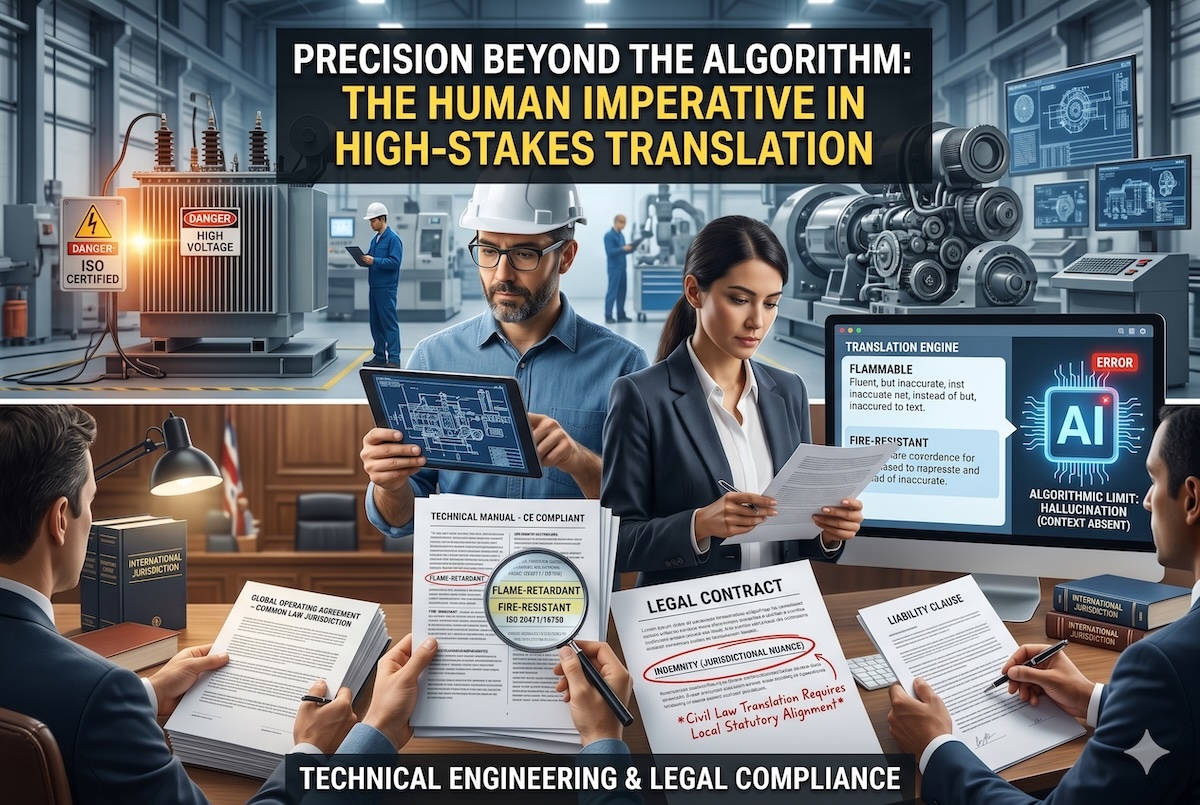
Consider a technical specification for a specialized industrial lubricant. An algorithm might translate a specific viscosity requirement correctly in a general sense but fail to capture the nuanced distinction between “flame-retardant” and “fire-resistant”—terms that carry specific ISO certifications. I know, it is a subtle nuance, but an important one nonetheless. When it comes to very specific terms, liability can be at stake. This is why an expert linguist with subject Matter expertise, justifies the cost of a professionally done Translation.
If a technician in a foreign plant follows a machine-translated manual that uses the wrong technical synonym, the result isn’t just a typo; it is a catastrophic equipment failure. Human precision in technical translation involves:
•
- Contextual Hardware Knowledge: Understanding how the physical machine operates to ensure the terminology aligns with real-world physics.
- Standardization Compliance: Ensuring that every term adheres to local regulatory bodies (such as CE marking in Europe or OSHA in the US).
- Measurement Integrity: Managing the complex conversion of units where rounding errors can compromise structural integrity.
Legal Compliance: Where One Comma Costs Millions
If technical translation is about physical safety, legal translation is about institutional survival. The legal world is built on the precise architecture of language. Here, the algorithm’s inability to grasp legal intent and jurisdictional nuance becomes a liability.
Jurisdictional Nuance
A contract is not just a collection of words; it is a set of obligations bound by a specific legal system (Common Law vs. Civil Law). An algorithm might translate the English term “Indemnity” into a Spanish or French equivalent that sounds correct but carries entirely different statutory obligations in a local court.
Human experts don’t just translate words; they perform comparative legal analysis. They recognize when a concept in the source language has no direct equivalent in the target jurisdiction and might need to be “transcreated” or explained through a translator’s note to maintain compliance.
The Liability of the Black Box
When a machine translation fails, who is responsible? In high-stakes litigation or patent filings, accountability is paramount. A certified human translator provides a trail of professional liability. They sign off on the accuracy, offering a guarantee that an algorithm—which cannot be sued for malpractice—never can.
In sectors like pharmaceuticals, where a mistranslated contraindication on a label can lead to criminal negligence charges, the “human-in-the-loop” isn’t a luxury; it is the fundamental pillar of risk management.
Why Algorithms Fail at High-Stakes Precision
To understand why we must look beyond the algorithm, we have to understand the inherent limitations of mathematical language processing.
- The Absence of “World Knowledge”
Algorithms lack “sentience” or “embodied cognition.” They do not know what it feels like to operate a crane, nor do they understand the tension in a courtroom. Human precision is fueled by world knowledge—the ability to visualize the consequence of a sentence. A human translator sees a warning label and thinks, “If I don’t get this right, someone gets hurt.” An algorithm thinks, “This word follows that word with 98% probability.” -
The Cultural Lexicon
Technical and legal documents are often steeped in local corporate or regional cultures. The way a Swiss engineering firm describes a process may differ significantly from a Canadian firm, even if they use the same base language. Humans detect these “micro-dialects.” Algorithms, trained on massive, undifferentiated datasets, tend to regress to the mean, erasing the specific cultural nuances required for true precision.
-
Ethical and Moral Judgment
In legal compliance, especially regarding human rights, data privacy (GDPR), or labor laws, translation requires moral judgment. Decisions must be made on how to communicate sensitive information without causing offense or legal breach. AI lacks the ethical compass to navigate these “gray zones.”
The Hybrid Future: Human-Centric AI
Moving beyond the algorithm does not mean abandoning technology. It means redefining the relationship between the tool and the master. The future of high-stakes translation lies in Expert Human-in-the-Loop (HITL) workflows.
Augmented Intelligence
In this model, the algorithm handles the “brute force” work—repetitive strings, basic vocabulary, and initial drafting. The human expert then steps in to perform:
- Technical Validation: Ensuring the terminology matches the specific engineering field.
- Legal Harmonization: Aligning the text with the target country’s legal framework.
- Tone and Intent Audit: Ensuring the document achieves its purpose, whether that is a binding agreement or a safety warning.
The ROI of Human Precision
Many organizations view human translation as a cost center, while seeing AI as a cost-saver. This is a short-sighted perspective. In high-stakes environments, the cost of human translation is essentially an insurance premium.
- Preventing Rework: It is significantly cheaper to pay a professional to get it right the first time than to recall 50,000 units of a product because the safety instructions were incomprehensible.
- Accelerating Market Entry: Accurate legal and technical documentation speeds up the approval process with local regulators. Mistranslations lead to “Requests for Information” (RFIs) that can delay a launch by months.
- Brand Integrity: For a technical company, precision is the brand. A sloppy translation suggests a sloppy product. Human precision ensures that the excellence of the engineering is reflected in the excellence of the documentation.
The Final Bastion of the Expert
We are living through a “Gold Rush” of automation, where the allure of speed and low cost often blinds us to the necessity of depth. However, in the realms where precision is a prerequisite for safety and legality, the human mind remains the ultimate arbiter of truth.
The algorithm is a map—often a very good one—but the human translator is the navigator who knows that the map is not the territory. They understand the wind, the terrain, and the stakes of the journey.
Precision beyond the algorithm is not a rejection of progress; it is an insistence on responsibility. In technical and legal compliance, we cannot afford to be “mostly right.” We must be exactly right. And for that, we will always need the human touch, the human eye, and the human conscience.
Key Takeaways for Decision Makers
- Risk Assessment: Identify which documents are “low stakes” (internal emails) and “high stakes” (contracts, safety manuals). Never use unedited machine translation for the latter
- Subject Matter Expertise (SME): Ensure your translators are not just linguists, but experts in your specific field of engineering or law.
- Verification Protocols: Implement a multi-stage review process where the final gatekeeper is always a human specialist.
In an era driven by automation, the organizations that thrive will not be those that replace human expertise, but those that elevate it. High-stakes translation demands more than linguistic fluency—it demands accountability, judgment, and precision. Technology can accelerate communication, but only human expertise can truly safeguard meaning, compliance, and trust. The future is not human versus AI, but human-guided AI built around responsibility and accuracy. Because when the stakes are high, “almost correct” is never enough.