In an era of global connectivity, the ability to communicate across language barriers is no longer a luxury—it is a legal and operational necessity. As organizations navigate the complexities of language access, one tool has emerged as the most versatile player in the field: (VRI).
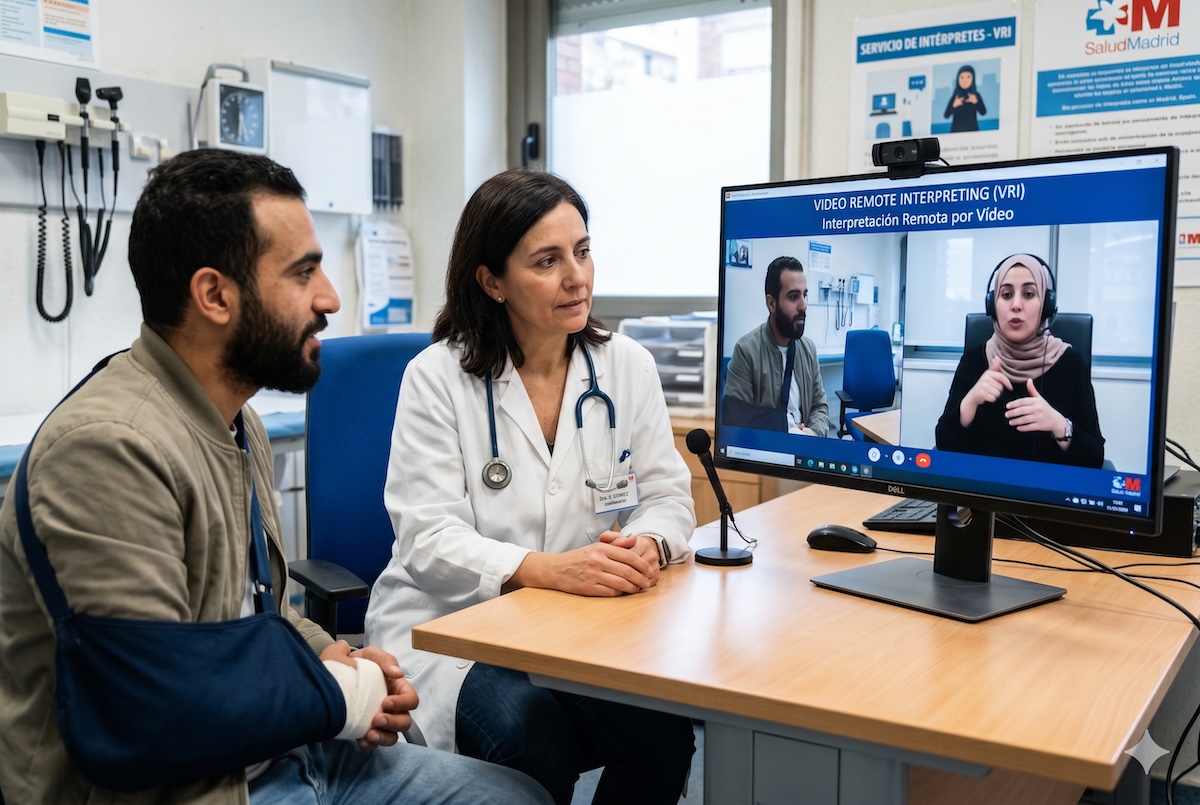
VRI is a video telecommunication service that uses devices such as tablets, laptops, or smartphones to provide spoken or sign language interpreting through a remote professional. However, the true value of VRI lies in knowing how to source it. Whether you are using On-Demand (per-minute) services, Prescheduled VRI (with a two-hour minimum), or the emerging frontier of AI-Driven Interpreting, the choice you make defines the quality of the interaction.
Where VRI Sines: Key Industries and Situations
VRI is the “Goldilocks” of interpreting: it provides the visual nuance that phone interpreting lacks, but with a speed and flexibility that in-person interpreting cannot match.
Healthcare: The Frontier of Patient Equity
In medical settings, communication is clinical data. VRI is most appropriate for:
- Emergency Room Triage: When a patient arrives in crisis, there is no time to wait for a physical traveler. On-demand VRI provides immediate visual access to assess pain levels and non-verbal distress.
Routine Consultations: For follow-ups where a physical exam isn’t the primary focus, VRI allows the doctor and patient to maintain eye contact, which is vital for building the therapeutic alliance.
The Legal Sector: Precision and Access
While high-stakes trials often demand in-person presence, VRI has revolutionized:
- Arraignments and Depositions: These are often short but require high-level legal certification. VRI allows courts to access certified interpreters for rare dialects without paying for four hours of travel time.
- Attorney-Client Consultations: Meeting a client in a correctional facility is logistically difficult. VRI provides a secure, visual platform to discuss sensitive case details without security clearance hurdles for the interpreter.
Corporate and Human Resources
Global businesses use VRI to foster inclusivity:
- Hiring and Onboarding: Interviewing a Deaf candidate or a remote international hire is seamless via VRI, ensuring that body language and sign language nuances are capture
- Technical Training: For small groups, VRI allows the interpreter to see what the trainer is pointing to, ensuring terminology is applied correctly to the physical task.
The Practical Distinction: On-Demand vs. Prescheduled VRI
One of the most common points of confusion for organizations is the “two-hour minimum” versus “per-minute billing.” Understanding this distinction is key to both fiscal responsibility and service quality.
On-Demand VRI (Billed by the Minute)
This is the “emergency” or “walk-in” model. You press a button on an app, and within 30 to 60 seconds, an interpreter appears.
- Best for: Unplanned encounters, brief status updates, front-desk interactions, or triage.
- The Advantage: You only pay for the time you talk. If the interaction lasts 12 minutes, you pay for 12 minutes.
- The Trade-off: You get the “next available” interpreter. You cannot request a specific person, and the interpreter has zero time to prepare for the context of your meeting.
Prescheduled VRI (Subject to a Two-Hour Minimum)
Just like in-person interpreting, prescheduled VRI involves booking a specific interpreter for a specific time. Because the interpreter is blocking their calendar and turning down other work, a two-hour minimum fee is standard. - Best for: Complex medical procedures, legal depositions, mental health therapy, or long-form training.
- The Advantage: Context. You can provide the interpreter with documents, names, and technical glossaries in advance. This ensures a significantly higher level of accuracy and professional continuity.
- The Trade-off: Higher cost. Even if the meeting ends in 45 minutes, you are committed to the two-hour fee.
The Rule of Thumb: If the interaction is unpredictable and short, go On-Demand. If the interaction involves specialized terminology or sensitive emotional weight, Preschedule.
The New Frontier: AI On-Demand Interpreting
A significant recent development is the introduction of AI-Driven Interpreting for on-demand needs. This technology uses advanced Large Language Models (LLMs) to provide real-time speech-to-speech translation.
When is AI appropriate? AI is designed for low-risk, high-frequency situations.
- Examples: A patient asking for an extra blanket, a guest checking into a hotel, or a student asking where the library is.
- The Advantage: It is virtually instant and significantly more cost-effective than a human interpreter.
- The Warning: AI should never be used for informed consent, legal advice, or complex medical diagnoses where the nuance of human emotion and cultural “filtering” is required to prevent life-altering errors.
VRI vs. Other Modalities: A Strategic Comparison
| Feature | Over-the-Phone (OPI) | (VRI) | On-Site (In-Person) |
| Billing | Per minute | Per minute (On-Demand) or 2hr Min (Scheduled) | 2hr Minimum + Travel |
| Visual Cues | None | High (Head/Shoulders) | Full (3D Presence) |
| ASL Support | No | Yes | Yes |
| Best For | Data-heavy calls (Banking) | Clinical/Legal/Deaf Access | Trauma/Complex Group Dynamics |
VRI vs. On-Site
On-site is the “premium” service. It is best for psychiatric evaluations, small children, or end-of-life care where physical presence provides comfort. However, it is expensive and hard to source in rural areas. VRI provides 90% of the benefit of on-site interpreting at a fraction of the cost and with 100% more geographic availability.
VRI vs. OPI
OPI is great for “blind” transactions (e.g., “I need to pay my electric bill”). However, in any face-to-face setting, OPI is clunky. Without visual cues, the interpreter cannot see if a patient is nodding “yes” while looking terrified. VRI bridges this gap, making the interpreter a “part of the room.”
Identifying the Appropriate Modality: An Educational Guide
Choosing between a per-minute on-demand interpreter and a prescheduled one is a matter of Clinical/Legal Depth.
Scenario A: The ER Triage (Use On-Demand Per-Minute) A patient arrives with a broken arm. You need to know their name, allergies, and when the pain started. A per-minute VRI interpreter is perfect here. The vocabulary is standard, the duration is short, and the need for speed outweighs the need for a specific interpreter.
Scenario B: The Oncology Results (Preschedule with 2-Hour Minimum) A doctor is explaining a cancer diagnosis and treatment plan. This requires a specific emotional cadence and mastery of highly technical terminology. By prescheduling a VRI interpreter, you ensure that a specialist is assigned, they have reviewed the case notes, and they are prepared for the emotional weight of the conversation. Using an on-demand interpreter here risks a “disconnect” if the randomly assigned interpreter isn’t comfortable with the subject matter.
Advantages of the VRI Model
Visual Clarity for ASL: For the Deaf and Hard-of-Hearing community, VRI is a lifeline. It captures the facial expressions and “visual grammar” essential to American Sign Language.
- Reduced “No-Show” Risk: On-site interpreters can get stuck in traffic. VRI interpreters are always just a click away.
- Infection Control: In post-pandemic healthcare, VRI allows for high-quality interpreting without introducing an extra person (and potential germs) into a sterile environment
- Environmental Impact: By eliminating travel, VRI significantly reduces the carbon footprint of language services.
The future of language access is not a single path, but a multi-lane highway. On-demand VRI offers the speed we need for the unpredictable moments of life. Prescheduled VRI offers the depth and precision required for our most important milestones. And AI interpreting offers a scalable solution for the simple interactions that make a day run smoothly.
By understanding these distinctions—especially the value of the two-hour minimum for scheduled expertise versus the per-minute agility of on-demand—organizations can provide truly equitable access to every individual, regardless of the language they speak or the way they communicate.