Bridging the Linguistic Divide: Understanding Translation and Interpreting in a Globalized World
In today’s global environment, organizations operate across languages and cultures on a daily basis. In this context, effective multilingual communication is not just a convenience—it is essential to ensuring operational efficiency, regulatory compliance, and positive outcomes across industries such as healthcare, legal services, and international business.
Misunderstandings in multilingual communication are not simply linguistic issues—they can lead to delays, compliance risks, financial exposure, and compromised outcomes.
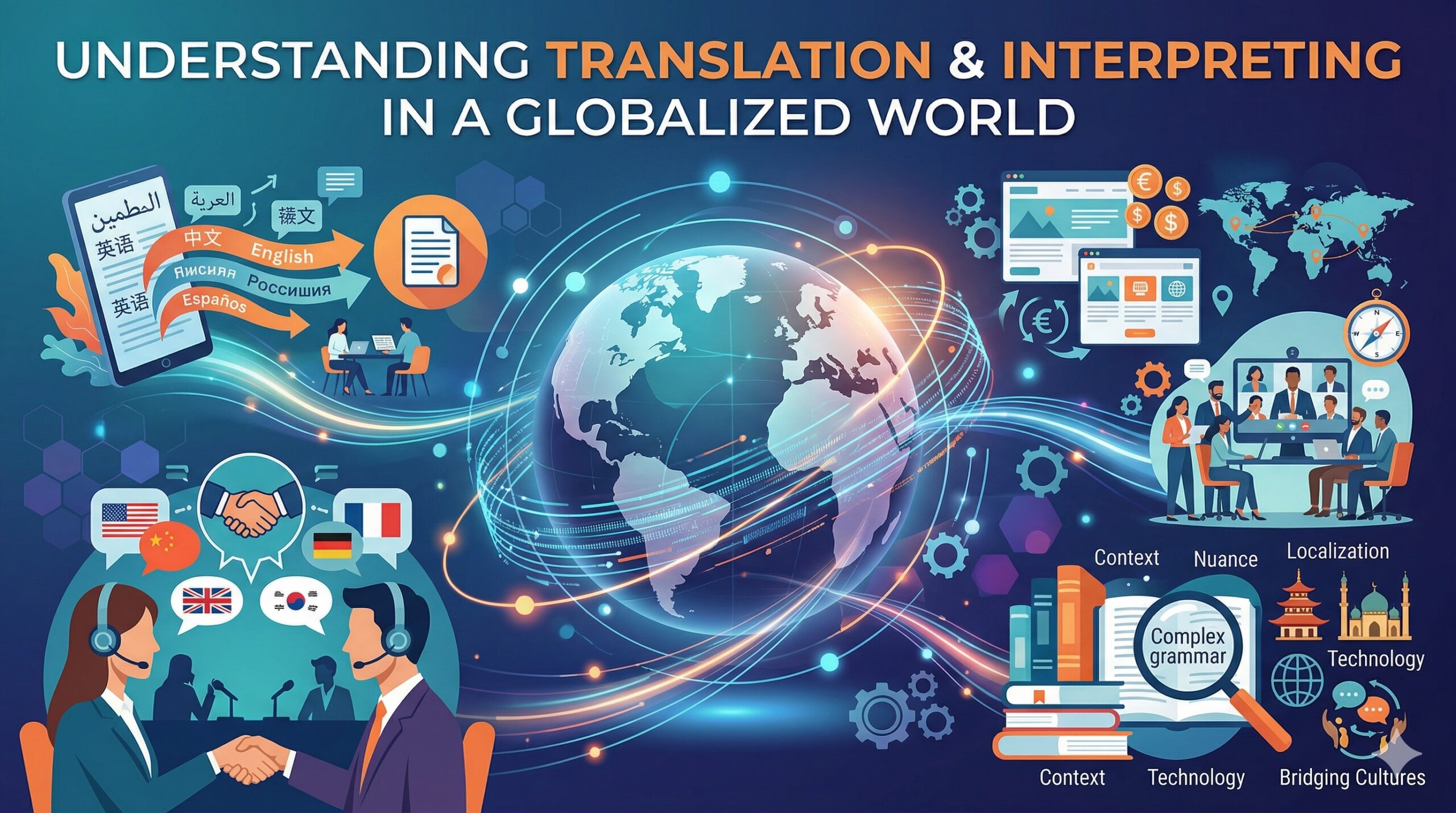
However, a common misconception persists that “translation” and “interpreting” are interchangeable terms for the same task…and they are not. While both disciplines share the goal of facilitating communication between different languages, they are distinct professions requiring unique skill sets, technologies, and cognitive approaches.
Understanding the nuances between written translation and oral interpreting is essential for any organization or individual operating in a multicultural environment. Recognizing the role of trained professionals is key to ensuring accurate, culturally appropriate, and reliable communication.
The Written Word vs. The Spoken Voice
The most fundamental distinction between translation and interpreting lies in the medium of communication.
Translation: The Art of Precision in Writing
Translation deals exclusively with written content. A translator’s task is to take a source text—whether it be a legal contract, a technical manual, a marketing brochure, or a literary novel—and recreate it in a target language.
The hallmark of translation is precision and reflection. Because translators work with static text, they have the ability to consult terminology resources, leverage Translation Memory (TM) tools, and conduct research to ensure consistency and accuracy.
A strong translation is not a literal word-for-word conversion. It requires adapting tone, style, and intent so that the final text reads naturally in the target language while preserving the original meaning. This process often involves multiple review stages and quality assurance measures.
Interpreting: The Agility of Real-Time Speech
Interpreting is the oral (or sign language) transfer of a message from one language to another in real time. Unlike translation, it does not allow for revisions or second drafts.
Interpreters must listen, process meaning, and deliver the message almost instantaneously. The focus is on accurately conveying intent, tone, and context while maintaining the natural flow of communication.Because interpreting occurs live, it requires exceptional concentration, mental agility, and the ability to perform under pressure in environments where clarity is critical.
Modalities of Interpreting: Meeting Diverse Needs
Interpreting takes different forms depending on the setting and requirements:
- Simultaneous Interpreting: Common in large conferences or international events, where the interpreter speaks almost at the same time as the speaker using specialized equipment.
- Consecutive Interpreting: The speaker pauses periodically, allowing the interpreter to render the message. This is often used in meetings, medical consultations, or legal proceedings.
- Over-the-Phone (OPI) and Video Remote Interpreting (VRI): These remote modalities provide immediate access to language professionals, making them essential for healthcare, emergency services, and high-volume environments.
These modalities allow organizations to access qualified language professionals in real time or on demand, ensuring continuity of service even in time-sensitive or high-volume environments.
- Sight Translation: A hybrid modality where a written document is read and rendered orally in another language, often used in legal or medical contexts.
The Specialized Skills of Language Professionals
A common misconception is that bilingual individuals can automatically perform translation or interpreting. In reality, professional language services require a distinct and highly developed skill set.
Cognitive Load and Mental Agility
Interpreters must manage multiple cognitive processes simultaneously—listening, analyzing, and speaking—often under significant time constraints. This level of cognitive demand is comparable to some of the most mentally intensive professions.
Subject Matter Expertise
Language professionals often specialize in fields such as healthcare, legal services, finance, or engineering. This ensures accurate use of terminology and alignment with industry-specific standards and expectations.
Cultural Competence
Language is deeply tied to culture. Effective communication requires more than linguistic accuracy—it requires understanding cultural nuances, idiomatic expressions, and context. Professionals act as cultural mediators to ensure messages are both accurate and appropriate.
Why Professional Training Matters: The Global Arena Advantage
The stakes of ineffective communication can be significant. In healthcare, errors can impact patient safety. In legal settings, misunderstandings can affect due process. In business, miscommunication can lead to financial and reputational consequences.
At Global Arena, we recognize that effective multilingual communication goes beyond linguistic ability. It requires structured processes, trained professionals, and solutions designed to align with each client’s operational, cultural, and regulatory context.
Through targeted training and real-world application, language professionals develop the skills needed to deliver consistent and reliable outcomes.
Improving Accuracy and Consistency
Professional training emphasizes terminology management, structured workflows, and quality assurance practices to ensure consistency across projects and interactions.
Cultivating Cultural Awareness
Training environments often simulate real-world scenarios where cultural nuances are critical. Professionals learn to interpret not only words, but also tone, intent, and non-verbal communication.
Professional Ethics and Confidentiality
Trained professionals adhere to strict ethical standards, including confidentiality, impartiality, and accuracy. These principles are essential in sensitive environments such as healthcare, legal proceedings, and social services.
Our approach integrates human expertise with technology-enabled workflows, ensuring both scalability and quality across translation and interpreting services.
The Human Element in a Digital Age
While machine translation and AI-driven tools have significantly improved, they still struggle with nuance, context, and cultural sensitivity.
For high-stakes communication—where accuracy, empathy, and clarity are essential—human expertise remains indispensable.
Translation and interpreting are complementary disciplines that play a critical role in enabling communication across languages and cultures. One provides precision and permanence in written communication, while the other enables real-time understanding and interaction.
Ultimately, effective language services enable organizations to communicate clearly, reduce risk, and operate confidently across multilingual environments.